

The best things to do in Tucson, Arizona combine Sonoran Desert scenery with genuine Southwestern culture: Saguaro National Park for cactus-forest hiking, the Arizona-Sonora Desert Museum for wildlife up close, Mission San Xavier del Bac for 300-year-old Spanish colonial architecture, and downtown Tucson’s restaurant scene, recognized by UNESCO in 2015 as America’s first International City of Gastronomy.
Tucson works well as both a weekend trip and a base for exploring Southern Arizona, since it sits close to day-trip towns like Bisbee and Tombstone. Whether you’re visiting for outdoor adventure, food, or history, this guide covers what’s actually worth your time, what it costs, and when to go.
Table of Contents
- Explore the Sonoran Desert
- Culture, History & Museums
- Food: Why Tucson Is a UNESCO City of Gastronomy
- Outdoor Activities & Day Trips
- Fun Things to Do in Tucson for Adults
- Best Time to Visit Tucson
- Practical Tips & Sample 3-Day Itinerary
- FAQs
Explore the Sonoran Desert

Tucson’s biggest draw is the Sonoran Desert itself, and two attractions let you experience it properly: Saguaro National Park and the Arizona-Sonora Desert Museum.
Saguaro National Park is split into two districts on either side of the city — Saguaro West (Tucson Mountain District) and Saguaro East (Rincon Mountain District) — both protecting forests of the giant saguaro cactus, a plant that grows naturally nowhere else on Earth. Entrance costs $25 per private vehicle or $15 per person on foot or bike, and the pass is valid for 7 days across both districts. Saguaro West is closer to downtown and better for short visits; Saguaro East has longer trails for a half-day hike.
The Arizona-Sonora Desert Museum, founded in 1952, is part zoo, part botanical garden, and part natural history museum spread across roughly 98 acres. General admission runs around $20 for adults, and since 85% of the museum is outdoors, plan around the season — early morning visits are far more comfortable from May through September.
Culture, History & Museums
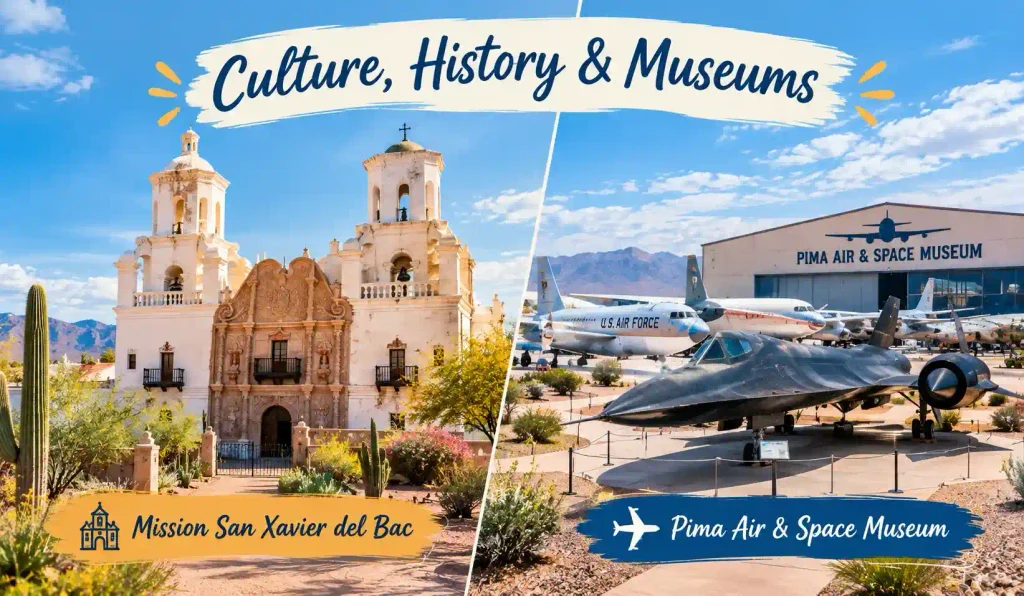
Tucson’s history runs deeper than most Southwestern cities, and it shows in sites like Mission San Xavier del Bac and the Pima Air & Space Museum.
Mission San Xavier del Bac, nicknamed the “White Dove of the Desert,” was founded in 1692 by Jesuit missionary Father Eusebio Kino and is considered the oldest intact European-built structure in Arizona. It sits about 12 miles south of downtown Tucson, admission and parking are free, and the interior features hand-carved statues and original frescoes rarely found this well preserved outside Mexico.
Pima Air & Space Museum holds one of the largest aircraft collections in the world — over 300 aircraft across 80 acres, including a replica Wright Flyer and an SR-71 Blackbird. Budget at least 3 hours if you want to see the hangars properly, plus extra time for the optional bus tour of the nearby “boneyard” (AMARG), the Air Force’s aircraft storage facility.
Food: Why Tucson Is a UNESCO City of Gastronomy

Direct answer: Tucson was named UNESCO’s first International City of Gastronomy in the United States in 2015, largely on the strength of its 4,000-year continuous agricultural history and its deep Sonoran-Mexican food traditions.
This isn’t a marketing label — it shows up on the plate. The city’s “23 Miles of Mexican Food” stretch along South 12th Avenue is a real local shorthand for the density of taquerias and family-run restaurants packed into that corridor. If you only try one Tucson-specific dish, make it a Sonoran hot dog: a bacon-wrapped hot dog piled with beans, tomato, onion, and jalapeño salsa, sold from carts across the city and rarely found this way anywhere else.
Outdoor Activities & Day Trips

- Sabino Canyon — desert canyon trails with seasonal waterfalls and a narrated tram tour; a day pass costs around $5.
- The Loop — a paved, car-free trail system connecting parks and neighborhoods across the city, ideal for biking or a flat morning walk.
- Colossal Cave Mountain Park — guided tours through one of North America’s largest dry caves, plus horseback riding on-site.
- Bisbee — a former copper-mining town turned artist colony, roughly a 2-hour drive southeast.
- Tombstone — the Old West town famous for the O.K. Corral gunfight, about 70 miles southeast of Tucson.
Fun Things to Do in Tucson for Adults
Beyond the desert and the history, Tucson has a low-key but distinct nightlife and craft scene worth building an evening around:
- Whiskey Del Bac distillery tour — a Tucson-made mesquite-smoked whiskey, with tastings and tours available.
- Fourth Avenue — a walkable strip of vintage shops, bars, and live-music venues near the University of Arizona.
- Monsoon Chocolate — a small-batch, bean-to-bar chocolate maker downtown, good for an evening dessert stop.
- Old Town Artisans — galleries and craft shops in the historic El Presidio district, best paired with dinner downtown.
- Golf at a Catalina Foothills course — several championship courses here run year-round with mountain-view fairways.
Best Time to Visit Tucson
Tucson is the sunniest major city in the United States, but that sunshine gets extreme in summer. October through April brings mild days (60s–80s°F) and is the most comfortable stretch for hiking Saguaro National Park or walking the Presidio trail. May through September pushes well past 100°F most afternoons, so outdoor plans need to shift to early morning or evening.
Practical Tips & Sample 3-Day Itinerary
- Rent a car. Tucson’s attractions — the Desert Museum, both Saguaro districts, and Mission San Xavier — are spread out enough that public transit isn’t practical for a full itinerary.
- Start outdoor activities before 9 AM from May to September to avoid peak heat.
- Buy the Saguaro pass once — it covers both East and West districts for 7 days, so you don’t need to pay twice.
- Carry more water than you think you need — the desert air is deceptively dry, and dehydration sets in faster than it feels.
Sample 3-day itinerary:
- Day 1: Arizona-Sonora Desert Museum (morning) → Saguaro West (afternoon) → dinner on South 12th Avenue
- Day 2: Mission San Xavier del Bac (morning) → Pima Air & Space Museum (afternoon) → Fourth Avenue (evening)
- Day 3: Sabino Canyon hike (morning) → Old Town Artisans and downtown shopping (afternoon) → optional day trip to Bisbee or Tombstone if extending the trip
FAQs
What is Tucson, Arizona best known for?
Tucson is best known for Saguaro National Park, the Arizona-Sonora Desert Museum, and its status as America’s first UNESCO City of Gastronomy, awarded in 2015.
How many days do you need in Tucson?
Three days covers the main attractions comfortably — the Desert Museum, Saguaro National Park, Mission San Xavier del Bac, and downtown’s food scene — with a fourth day useful if you want to add a Bisbee or Tombstone day trip.
Is Saguaro National Park worth visiting?
Yes. It’s the only place on Earth where the giant saguaro cactus grows naturally, and both districts offer trails ranging from 30-minute walks to half-day hikes.
What is there to do in Tucson for free?
Mission San Xavier del Bac has free admission and parking, and The Loop trail system is free to walk or bike at any time.
Is Tucson a good place for a Mexican food trip?
Yes — Tucson was named UNESCO’s first U.S. International City of Gastronomy in 2015, largely due to its deep Sonoran-Mexican food traditions along corridors like South 12th Avenue.
What’s the best time of year to visit Tucson?
October through April, when daytime temperatures sit in the 60s to low 80s°F, making outdoor activities like hiking and museum visits far more comfortable than the summer heat.
Do you need a car in Tucson?
Yes, for the most part. Major attractions like the Desert Museum, both Saguaro districts, and Mission San Xavier del Bac are spread across the city and not well connected by public transit.
What are the best day trips from Tucson?
Bisbee (about 2 hours) and Tombstone (about 70 miles) are the two most popular day trips, both offering Old West and mining history southeast of the city.
Conclusion
Tucson rewards visitors who mix its desert landscapes with its food culture — a morning at Saguaro National Park pairs naturally with an evening on South 12th Avenue’s taco corridor. Plan around the heat, rent a car, and give yourself at least three days to cover the Desert Museum, Mission San Xavier del Bac, and downtown without rushing.
